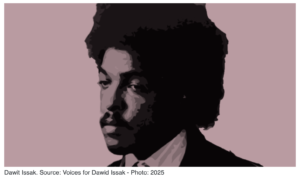
ANALYSIS. Diplomats tend to avoid risks and settle for partial results. But for Swedes imprisoned in Iran, China and Eritrea, this is a disastrous approach, writes Susanne Berger from the Raoul Wallenberg Centre for Human Rights and Caroline Edelstam from the Edelstam Foundation.
Article by Susanne Berger, Senior Fellow, the Raoul Wallenberg Centre for Human Rights, and Caroline Edelstam, Co-Founder and President of the Edelstam Foundation, published in November 27, 2025 in Global Bar Magazine.
If the Swedish Foreign Ministry were a country, it would rank among the most isolationist, least participatory societies in the world.
Years ago, during the official investigation of the fate of Swedish diplomat and Holocaust hero Raoul Wallenberg in Russia, researchers would huddle to discuss how to move the inquiry forward. The group felt that if they could just convince Swedish officials to tackle the issue in more creative ways, to seek answers from unexpected sources, such an approach could yield important progress.
It took years before the realization finally set in that the seeming foot dragging by Swedish diplomats was not due to a lack of understanding, a failure to recognize the value of the proposed steps, or obscure bureaucratic hurdles. They simply did not want to act.
This institutional aversion towards cooperating with outsiders has proved to be a major obstacle in the handling of current cases of Swedish citizens missing or arbitrarily detained abroad. Swedish officials prefer to deal with politically sensitive matters strictly “in house”, keeping their cards tightly to their vest and any third parties firmly at bay, even when seemingly at their most openminded and inclusive.
An inherent conflict of interest
Above all, family members are experiencing firsthand how much the Swedish Foreign Ministry has closed itself off not only from them, but also from any outside scrutiny. Representatives of the public – human rights advocates, journalists, even parliamentarians or legal counsels – are kept at arm’s length. Obfuscation, evasion, delays, the feigning of ignorance are all tools to avoid direct interaction and cooperation. When this fails and Swedish officials feel pressured, they resort first to anger, only to shut themselves off even more, by not responding to inquiries or invoking Sweden’s strict secrecy provisions.
Representatives of the public – human rights advocates, journalists, even parliamentarians or legal counsels – are kept at arm’s length.
Both families and their advocates emphasize that they do not want to take an adversarial position. In fact, they want nothing more than for Swedish officials to succeed. None of this appears to register or bring about any meaningful change.
Part of the problem is, of course, that Swedish diplomats primarily represent Swedish national interests which creates an inherent conflict. It means that the goals of families and those of the Swedish government do not always coincide. Families have only one aim – to free their loved ones. Diplomats have many other factors to consider which makes them naturally risk averse. It also makes them far more inclined to accept partial solutions.
Avoiding collateral damage
Since the end of the Second World War, the Swedish government’s more or less unilateral approach – both in the international arena and at home – has registered some important successes. But the overall record of unsolved cases and desperate families remains dismal.
It begs the question if a full resolution of pending cases would bring revelations or any negative publicity that the Swedish government would prefer to avoid. This may well be a factor in some of the continuing Cold War era investigations, like the Soviet downing of a DC-3 aircraft in 1952 with eight (possibly nine) men on board; the Raoul Wallenberg inquiry; the loss of more than a dozen Swedish ships with 100+ missing sailors; or the still unsolved 1961 death of UN General Secretary Dag Hammarskjöld; and, more recently, the murder of Swedish Prime Minister Olof Palme in 1986, the various foreign submarine incursions into Swedish territorial waters; and the 1994 MS Estonia ferry disaster which left 852 people dead. Hence perhaps the readiness to settle for incomplete results.
It is not like Swedish officials lacked important leverage in these inquiries – yet they repeatedly refused to employ it. For example, in 1963, the Swedish Security Police (SÄPO) detained one of the Cold War’s most important Soviet agents, Swedish Air Force Colonel Stig Wennerström, but the government repeatedly failed to press its advantage with Soviet authorities. The same happened in 1981, when a Soviet submarine and its crew were stranded in Swedish territorial waters.
Read the full article on Global Bar Magazine’s web covering the following topics:
- A narrow political calculus
- The Prime Minister ignores official correspondence
- A profound lack of urgency and political will
- National interests before human rights
- How to define “success”?

Swedish version
A shorter version of this article was previously published in Swedish “Så förvandlar regeringen misslyckande till en framgång”. You can read it here.
Read it on Substack

Global Bar Magazine is Sweden’s leading independent publication focusing on global development, human rights, sustainability, and aid, offering in-depth analysis and perspectives often overlooked by mainstream media, especially from the Global South, also known as Globala Nyheter. They publish articles in Swedish, English, and Spanish, supported by podcasts (Global Podd), newsletters, and live discussions (Global Bar) to promote deeper understanding of world issues and advocate for global justice.